Does this AI app train on your chats? Every cell cited.
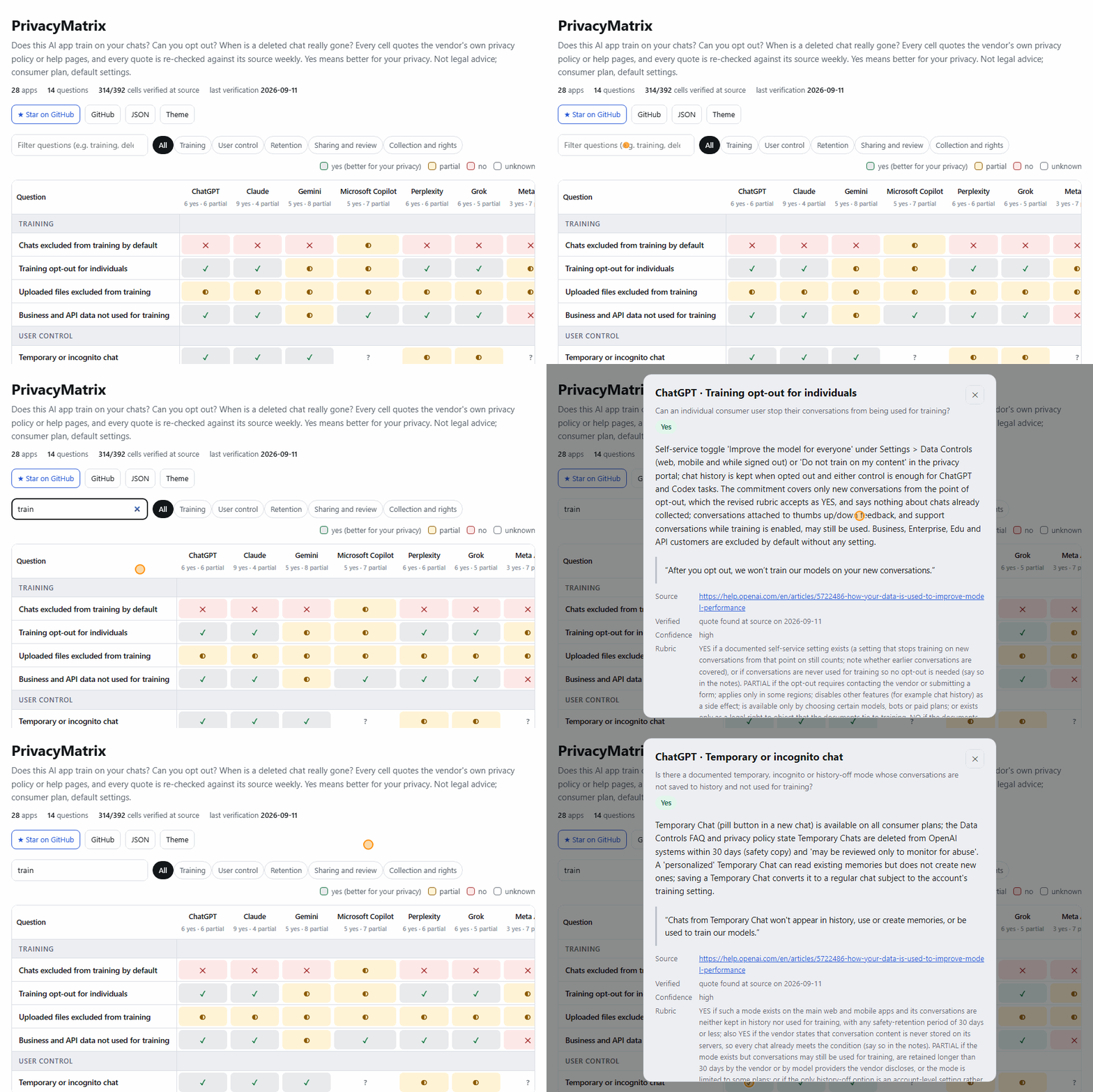
PrivacyMatrix compares 28 consumer AI assistant apps across 14 privacy questions. Each of the 392 cells stores the sentence from the vendor's own privacy policy, terms or help center that justifies it, the URL of that page, and the date the sentence was last found there. Every question is phrased so that "yes" is the better answer for your privacy. A free GitHub Action re-checks every quote weekly.
The problem
"Does ChatGPT train on my conversations? Can I turn it off? If I delete a chat, when is it really gone? Does Meta AI use what I ask it to pick ads?" People ask these questions every day, and the answers they get are usually a months-old news article, a screenshot of a settings page, or a confident guess. The policies themselves are long, change quietly, and are almost never compared side by side with the actual sentences that matter.
PrivacyMatrix answers from the documents and shows its work. It is the second product built on the engine behind AgentMatrix, the cited feature matrix of AI coding agents: the same pipeline, pointed at privacy policies instead of developer documentation.
What is different
- Every value has a receipt. A cell is only shown as yes, partial or no when its quote was found, verbatim, at the linked URL. Formatting differences are tolerated (whitespace, capitalisation, punctuation, smart quotes), wording differences are not.
- Yes always means better for your privacy. "Chats excluded from training by default: yes" means the policy says your conversations are not used for training unless you opt in. The count of yes answers under each app name is a rough privacy score; the cells are the real answer.
- Silence is never read as an answer. If the documents do not address a question the cell is unknown, not no. Vendors are not accused of practices their documents do not describe, and they are not credited with protections their documents do not state.
- Quotes are re-checked every week, for free. A GitHub Action re-fetches every source page and searches for every quote. A quote that is not found opens an issue at once; if it is still missing a week later its cell is demoted to unknown. A rewritten policy can make the table go stale into "unknown"; it cannot leave a stale "yes" standing.
- The decision rule is written down. Each question has a rubric that says exactly what counts as yes, partial or no (for example: a self-service setting that stops training on new conversations is yes; an opt-out that exists only as a regional legal right is partial; training on by default with no documented way to stop it is no). A disagreement about a cell is a disagreement about the rubric, and the rubric is versioned in the repository.
What the matrix covers
Apps (28): ChatGPT, Claude, Gemini, Microsoft Copilot, Perplexity, Grok, Meta AI, DeepSeek, Vibe (formerly Le Chat, Mistral), Character.AI, Poe, Pi, You.com, Kimi, Qwen Chat, Duck.ai, Brave Leo, Lumo (Proton), HuggingChat, Replika, Apple Intelligence and Siri, Alexa+, Snapchat My AI, Kagi Assistant, Venice, Manus, Genspark, Z.ai.
Questions (14), in five groups:
What the data says (September 2026)
A few rows that stood out while building it. Every claim below is backed by the same evidence the matrix shows; open the live matrix and click the cell to read the quote.
| Question | Finding |
|---|---|
| Chats excluded from training by default | No for 18 of 28, including ChatGPT, Claude, Gemini, Perplexity, Grok, Meta AI, DeepSeek and Vibe: consumer conversations are used for training unless you act. Yes only for five products that never store chats on their servers or state that they do not train at all: Duck.ai, Brave Leo, Lumo, Kagi Assistant and Venice. |
| Training opt-out | Yes for 12: a self-service setting exists (ChatGPT, Claude, Perplexity, Grok, DeepSeek, Vibe, Pi) or training never happens. Partial for 10 where the way out is a form, an email, a regional legal right or a paid plan (Gemini, Copilot, Meta AI, Character.AI, Poe, Kimi, HuggingChat, Replika, Alexa+, Z.ai). No for You.com, Qwen Chat, Apple's Siri transcripts and Snapchat My AI: training is on by default and the documents describe no way to stop it. |
| Uploaded files | Uploads follow the chats almost everywhere: partial for 16 apps whose files are trained on by default but covered by the same opt-out. Only the same five no-storage products score yes. |
| Business and API data | Yes for 11: business, team and API customers are excluded from training by default (ChatGPT, Claude, Copilot, Perplexity, Grok, Kimi, Qwen, Lumo, Venice, Genspark, Z.ai). Meta AI is the only no: its GenAI page lists data from products built by external developers as a training source without an exclusion. |
| Temporary or incognito chat | Yes for seven (ChatGPT, Claude, Gemini, Poe, Duck.ai, Brave Leo, Lumo). Unknown for 15: most vendors do not document such a mode at all. Snapchat My AI is the one explicit no: everything shared with it is stored until you delete it. |
| Deleted chats purged within 30 days | The weakest row. Yes only for Duck.ai, Brave Leo and Kagi Assistant. Twenty apps are partial, usually because a 30-day figure exists for chats but not for account data, or because copies already de-identified for training are kept (ChatGPT, Claude, Grok). |
| Chats not used for advertising | No for six: ChatGPT's free tier, Microsoft Copilot, Meta AI, Character.AI, You.com and Snapchat My AI select or personalise ads with conversation content. Yes for 13, including Claude, Gemini, DeepSeek, Vibe and Apple. |
| Sale or sharing for marketing | Yes for 10. Partial for 12, almost always the same pattern: no sale, but "sharing" under US state privacy law through advertising cookies, with an opt-out. Snapchat is the one no: My AI queries with commercial intent are disclosed to advertising partners. |
| Human review | Yes for six that either never store chats or limit human access to user-initiated cases (Claude, Vibe, Duck.ai, Brave Leo, Lumo, Replika). Partial for 13 that also disclose review for quality or training. Nine vendors do not mention human access at all. |
| Documented channel for data rights | The most universal protection: yes for 23 of 28. Every vendor documents some way to exercise access, deletion or portability rights. |
| Per app | Lumo scores 13 yes out of 14; Duck.ai and Brave Leo 11; Claude, Vibe and Kagi Assistant 9. ChatGPT scores 6 yes and 2 no. Alexa+ scores 0 yes with 7 unknowns: Amazon's documents for the new assistant are thin. Snapchat My AI collects the most no answers (6). |
What it does not tell you
- Documents, not behaviour. A cell says what the policy states, not what the vendor does. Nothing here audits practice.
- Regional variants. The matrix scores the global or US version of each policy. Meta, for example, serves different English variants by region, and EU users often have objection rights the US text does not describe. Differences are recorded in the notes of a cell, not in its value.
- Fetchability. Character.AI, Qwen Chat and Manus publish their policies only through JavaScript, so their cells cite the vendor's own script bundles; those URLs change on deploy and the weekly check will demote the cells when they do. OpenAI, Perplexity and xAI refuse requests from cloud IP ranges, so the weekly Action cannot re-check those 40 cells at all; each run lists them as unreachable and maintainers re-verify them from an ordinary connection.
How it works
Two loops, one free and one that costs API credits.
Every week, free
1. fetch every evidence URL in data/matrix.json (policy pages as text)
2. search each page for the cell's quote, tolerating formatting but not wording
3. quote found      -> verified_at = today
   quote missing    -> first time: cell kept and flagged, listed in an issue for a human
                       still missing a week later: value = "unknown"; old quote, URL and
                       value stay in the notes
   page unreachable -> cell untouched, reported
4. no value changed -> the refreshed dates are committed
   values changed   -> a pull request and an issue list the affected cells for a human
When a policy changes, with an API key
1. fetch every source page listed for the app in data/apps.json
2. Claude reads all of it in one request and returns one JSON entry per question:
   value, verbatim quote, source URL, notes, constrained by a schema
3. every returned quote is searched for in the fetched text; a quote that is not found
   demotes the cell to "unknown" (a fabricated or paraphrased quote does not survive)
4. if the new answer is "unknown" but the previous verified quote is still on its page,
   the previous cell is kept, so one bad answer never erases good data
5. the result is diffed against the previous matrix and opened as a pull request
The initial data was researched the same way, then audited twice: once per app against the rubric, and once across all 28 apps for consistency, so that two vendors describing the same situation get the same value. The mechanical check proves that a sentence exists on a page. Whether the sentence supports the value is a judgment made by the rubric, the model and the reviewers, in that order. Cells are open to challenge: report one with a link to the policy.
What it costs
Nothing to run. GitHub Actions and GitHub Pages are free for public repositories, and the weekly quote check needs no API key. Re-deriving cells with Claude is paid by whoever runs it, with their own key: at list prices roughly $0.30 to $2 per app with claude-fable-5-1, on the order of $20 for a full pass over 28 apps. The repository ships no key, and it does not need one to stay honest.
Contributing
Six more apps are on the wanted list as good first issues: Doubao, Yuanbao, Ernie Bot, T3 Chat, Nomi and Chai. Adding one means listing its policy URLs in data/apps.json, filling the 14 cells (with your own key, by hand, or leaving them unknown for someone else), and running npm run check, which fails if any quote is not found at its URL. Questions are open for proposals too; a good proposal is phrased so that yes is the more protective answer and comes with a rubric two people would apply the same way.
- Repository: github.com/barbarkaragul-oss/privacymatrix (MIT)
- Live matrix: barbarkaragul-oss.github.io/privacymatrix
- Raw data: matrix.json, with a
CITATION.cffin the repo for citing it - Sister project: AgentMatrix, the same engine applied to AI coding agent CLIs
Türkçe özet
PrivacyMatrix, 28 yapay zekâ asistan uygulamasının (ChatGPT, Claude, Gemini, Copilot, Perplexity, Grok, Meta AI, DeepSeek, Mistral Vibe, Character.AI ve diğerleri) kullanıcı verisini nasıl işlediğini 14 gizlilik sorusu üzerinden karşılaştıran açık kaynak bir matris: sohbetler varsayılan olarak eğitimde kullanılıyor mu, vazgeçme seçeneği var mı, silinen sohbet 30 gün içinde gerçekten siliniyor mu, sohbetler reklam için kullanılıyor mu, insanlar okuyor mu. Her hücre, üreticinin kendi gizlilik politikasından ya da yardım sayfasından birebir bir alıntı, o sayfanın adresi ve alıntının son doğrulandığı tarihle birlikte saklanıyor; her soru "evet = gizliliğiniz için daha iyi" yönünde yazıldı. Ücretsiz bir GitHub Action her hafta bütün alıntıları kaynağında yeniden kontrol ediyor; kaybolan alıntı önce bir issue açıyor, bir hafta sonra hâlâ yoksa hücre "bilinmiyor"a düşüyor. Hukuki tavsiye değildir; belgelerin ne dediğini gösterir, şirketlerin ne yaptığını değil. Çalıştırması ücretsiz, lisansı MIT, verisi JSON olarak indirilebilir.